Conductor Is Joining Meta: What Changes, What to Export, and Where to Move
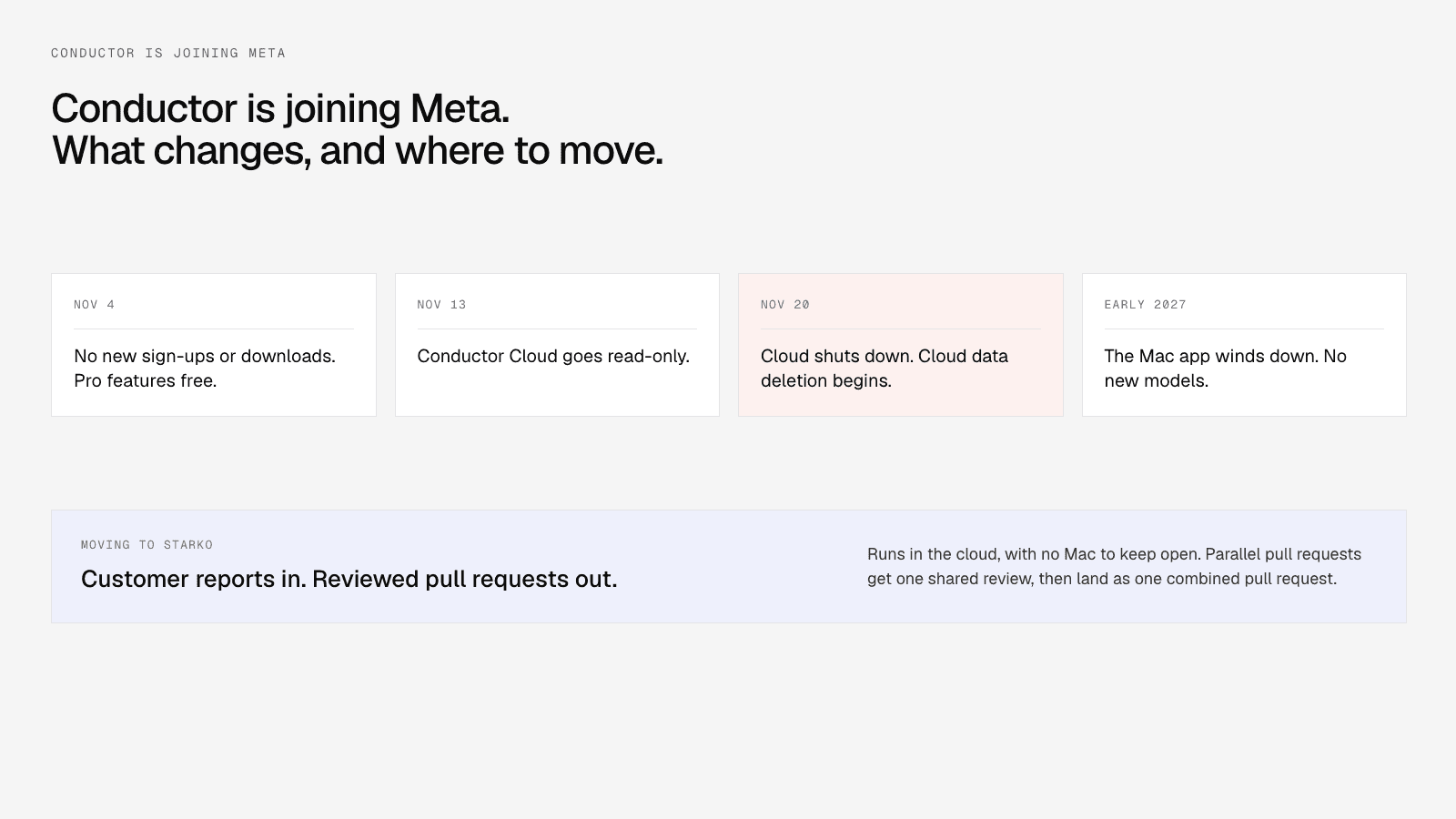
Meta has acquired Conductor, the Mac app that runs several coding agents side by side. Axios broke the news on November 4, 2026, and Conductor confirmed it the same day in its . New sign-ups stopped right away. Conductor Cloud goes read-only on November 13 and shuts down on November 20. The local Mac app keeps working until early 2027.
If your team uses Conductor, the next two weeks decide two things: getting your cloud work out safely, and choosing where your agents run next. This post covers both. We build Starko, so we're one of the options, and we'll say plainly where we're a good fit and where we aren't.
Key takeaways
- The deadline that matters is November 20. That's when Conductor Cloud shuts down and deletion of cloud data begins. Use "Transfer to local" or Settings → Account → Export data before then.
- The Mac app isn't dead yet. It keeps working, with new models and critical fixes, until early 2027. After that, Conductor will delete the app's user data.
- No new seats. Since November 4, nobody new can sign up or download the app, so a growing team can't add people.
- Pick an alternative by shape. For the same local, parallel-agent desktop app, look at other worktree apps. If your real bottleneck is deciding what agents should work on and reviewing what they produce, look at a software factory like Starko.
What happened to Conductor?
Conductor was built by Melty Labs, founded in 2024 by Charlie Holtz and Jackson de Campos. It raised a $22 million Series A in March 2026 from Spark Capital and Matrix, and says more than 100,000 people use it. On November 4, Holtz wrote that "Conductor is joining Meta," and the team is moving to Meta Superintelligence Labs, . Meta confirmed the deal but didn't share terms.
The same day, OpenAI announced plans to acquire Pierre Computer, . The large labs are buying the tools that sit on top of their models, so small developer tools in this space are getting absorbed fast.
Here is the timeline from Conductor's own announcement:
Conductor says active subscribers will get refunds and that it has never sold user data or trained models on it. Holtz has promised customers "something new" by early next year, but hasn't said what it is.
What should Conductor users do before November 20?
Move anything that lives only in Conductor Cloud to your Mac or to GitHub before November 13. After that date the cloud is read-only, and from November 20 the data starts to disappear.
- Transfer cloud workspaces to local. Right-click a cloud workspace and choose "Transfer to local." That moves the workspace and its chats to your Mac.
- Export a full archive. Go to Settings → Account → Export data. Keep the export even if you never plan to open it again, because chat history is often the only record of why a change was made.
- Push every branch you care about. A Conductor workspace is a git branch. Anything already pushed to GitHub is safe whatever happens to Conductor, and that includes open pull requests. Unpushed commits in a cloud workspace are not.
- Note your setup scripts. If you wrote workspace setup or run scripts, copy them into the repository. Whatever tool you use next will need the same install and environment steps.
- Email support with billing questions. Refunds go to active subscribers. The address is .
Why are teams looking for a Conductor alternative now?
For a solo developer, the local app working until early 2027 buys plenty of time. Teams have a harder problem. Nobody new can join, cloud workspaces are gone in two weeks, and the roadmap is now whatever Meta decides. A tool your workflow depends on just got an end date and an unknown replacement.
This is also a good moment to ask whether you still want the same kind of tool. Conductor was excellent at one job: putting several agents in front of one developer, in parallel, on a laptop. Its own reviewers kept hitting the same limit, though. More agents running at once means more diffs waiting for a human. The bottleneck moved from writing code to deciding what to build and checking what came back.
Which kind of tool do you actually need?
There are two shapes of product here, and they suit different teams.
A parallel-agent desktop app is what Conductor was. A developer types a prompt per workspace, watches each agent, reads each diff and opens the pull request. It fits a developer who already knows what to build and wants to drive several agents at once.
A software factory starts earlier and ends later. Work comes in from somewhere other than a developer's prompt, such as customer reports, error logs or Slack threads. The system turns that into a defined ticket, runs the agent in the cloud, checks the result and hands a person a pull request that's ready to merge. We cover the idea in depth in .
If you want the first shape, you have options. is the closest match: a Mac app that gives each branch its own git worktree and runs CLI coding agents side by side. Its source is published under the Elastic License 2.0, so check that license if open source matters to you. You can also run each agent's own CLI in a plain git worktree. It's less polished, but it has no vendor between you and your branches.
If the second shape sounds like your team's actual problem, the rest of this post is about Starko.
Why do Conductor teams move to Starko?
Starko is a software factory that starts from your customers. Support conversations, session replays, page errors, Slack threads and GitHub issues become tickets. Starko AI, Starko's own coding agent, works those tickets in a cloud sandbox and opens pull requests a person can review and merge. Here is what changes for someone coming from Conductor.
The work comes to you, already written up
In Conductor, every task started with a prompt you wrote. In Starko, a customer's report shows up as a ticket with the evidence attached: the conversation, the replay or the error. From there you choose Ask, Fix or Prototype, or click "Fix with Starko AI." You can also let Starko start runs on its own. The autonomy setting goes from "Off (only @starko mentions)" up to "Bugs, docs and small changes (xs/s)", so the factory only picks up as much as you allow.
Runs live in the cloud, not on your laptop
Conductor's free tier ran on your Mac, and cloud workspaces were the paid extra now being shut down. Every Starko run happens in a cloud sandbox that has your app running. The first setup takes about four minutes, and Starko AI by reading your repository. What it learns about your repo is saved for later runs, so nobody needs to keep a laptop open overnight.
Parallel work gets reviewed together, then lands once
This is the part Conductor never had. When several tickets should run at once, you ask Starko, in the ⌘L chat or in Slack, to send them as a crew. Before anything merges, one adversarial review reads all the crew's pull requests together. It catches the conflicts and overlaps that per-diff reviews miss, and sends each finding back to its ticket as a fix run. Then Starko merges the branches into a single combined pull request, reviews that once more, and hands it to a person with the merge order and any migration steps. Merging and migrations stay with a human.
If more agents meant more review work for you in Conductor, this is the fix.
Every pull request explains itself
A Starko pull request follows the same sections every time: Problem, Reproduction, Fix, Verification, Risk and Out of scope. Verified work carries the "Verified by STARKO" mark. You review the reasoning and the proof, not only the diff. The shows a real one from start to finish.
Anyone on the team can start work
Starko runs from the web app, from Slack and from the , so a product manager can file a ticket from Slack and still get a pull request. Starting runs and merging need the Integrations permission, so you decide who can ship.
No agent subscriptions to bring
Conductor users paid twice: once for Conductor, and once for their own agent subscriptions or API keys. Starko AI is built in. There's a free plan to start with, and paid plans after that. Check for the current numbers.
Where is Conductor better than Starko?
We'd rather you pick the right tool than switch and regret it. Conductor, or a tool like it, is the better choice if any of these describe you:
- You want a local app with zero setup. Starko needs a GitHub App install and a project setup before the first run. That's a few minutes of work, but it isn't "open the app and point it at a folder."
- You want to choose the agent brand per task. Conductor ran Claude Code, Codex and Cursor in one window. Starko runs Starko AI.
- You want to sit at the keyboard and drive. Starko sessions are tied to tickets and run in the cloud. You can steer a running session, but for rapid back-and-forth on a branch with no ticket, a local app has the tighter loop.
- You work alone, on your own ideas. A factory earns its keep when work arrives from customers and teammates. If every task starts in your head, a desktop app is simpler.
How do you move from Conductor to Starko?
The move takes an afternoon, and your code never has to leave GitHub.
- Rescue your Conductor data first. Transfer cloud workspaces to local, push branches and export your archive, as described above. Do it before November 13.
- Create a Starko workspace and install the GitHub App on the repositories your agents worked in. Your open pull requests and branches are already in GitHub, so nothing needs importing.
- Connect the project. Let Starko AI set up the sandbox. Point it at the setup scripts you copied out of Conductor if your app needs anything unusual.
- Check the merge settings during onboarding. Auto-merge is on by default. If your team is used to reviewing every diff by hand, turn it off for the first few weeks and turn it back on once you trust the review.
- Start with one ticket. Pick a small bug that has a clear customer report and click "Fix with Starko AI." Read the pull request sections and compare them with what you used to review in Conductor.
- Then send a crew. Once a single run looks right, ask Starko in the ⌘L chat or in Slack to send two or three related tickets as a crew, and watch the shared review do the work you used to do across several Conductor tabs.
Our guide on walks through the same steps in more depth, with every setting explained.
Conductor vs Starko at a glance
Frequently Asked Questions
Is Conductor shutting down?
Partly. Conductor Cloud goes read-only on November 13, 2026, and shuts down on November 20, 2026. The local Mac app keeps working, with new models and critical bug fixes, until early 2027. After that it winds down and its user data is deleted. Conductor says something new is coming early next year but hasn't said what.
Who acquired Conductor?
Meta acquired Conductor on November 4, 2026. The team, led by founder and CEO Charlie Holtz, joins Meta Superintelligence Labs. Meta confirmed the deal to TechCrunch but didn't share financial terms.
How do I export my Conductor data?
Right-click a cloud workspace and choose "Transfer to local" to move it and its chats to your Mac. For a full archive, go to Settings → Account → Export data. Do both before November 13, when the cloud goes read-only, and well before deletion starts on November 20.
Will Conductor refund my subscription?
Conductor says active subscribers will get a refund, including people who subscribed just before the announcement. Pro users also keep Pro features for free in the meantime. For billing questions, Conductor points users to .
What is the best Conductor alternative?
It depends on what you used Conductor for. To keep running several agents locally on your Mac, Superset is the closest match. If your team needs work to start from customer reports, run in the cloud, and land as reviewed pull requests rather than a pile of diffs, Starko is built for that. and run your first ticket the same day.