Background Coding Agents Compared (November 2026): Triggers, Sandboxes, Output and Real Pricing
At 9:40 on a Tuesday, a customer writes in to say the export button does nothing in Safari. By 10:30 there is a pull request that fixes it, with a screenshot of the working export attached. Nobody on the team opened an editor. One person read the diff, looked at the screenshot and clicked merge.
That is what a background coding agent does when it works. The harder questions are which one, started from where, running on whose machine, and billed how. Vendor pages answer those questions in nine different vocabularies, so this post puts them in one table and says what we think actually matters when you pick.
Key Takeaways
- A background coding agent takes a task, works in a cloud machine without you watching, and hands back a pull request.
- Agents differ on four things: where work starts, where it runs, what comes out and how you pay. The model matters less than you'd think.
- More than 40% of GitHub pull requests started from an agent's draft in September 2026 (GitHub Octoverse 2026). Review, not writing, is now the bottleneck.
- Judge an agent by what it hands the reviewer: a reproduction, test results, screenshots and a link to the reason the work exists.
What is a background coding agent?
A background coding agent is an AI agent that takes a coding task, clones your repository into its own cloud machine, works on it without a person watching, and returns the result as a branch or pull request for review. You hand it work and walk away. You come back to a diff, not a chat.
The difference from an IDE assistant is attention. An assistant in your editor works while you watch, one suggestion or one edit at a time, on your laptop. A background agent works while you do something else, on a machine you never see, and it can run five tasks at once while you run none.
That changes who can start work. With an editor assistant, only the developer at the keyboard can. With a background agent, a product manager can label an issue, a support lead can mention the agent in Slack, or a cron job can start one at 3am. The input moves away from the keyboard, and so does a lot of the judgment about what's worth building.
You'll also see these called cloud coding agents or async coding agents. The names overlap. What they share is the hand-off: you describe the task once, and the next thing you see is the result.
Four questions that separate one agent from another
Every vendor in this category claims the same model quality and the same speed. Those claims are hard to check and change monthly. Four other differences are stable, checkable and decide how the tool fits your team.
Where does work start?
Some agents start from a prompt you type in a web app or terminal. Others pick up a labeled GitHub issue, a Linear or Jira ticket, a Slack mention, a failed CI run or a schedule. The trigger decides who can delegate and how much context arrives with the task. A ticket written in a hurry gives the agent a hurried spec.
Where does it run?
The agent needs a machine with your code, your dependencies and ideally your services running. Options range from the vendor's cloud VMs to GitHub Actions runners to your own VPC. The questions to ask: can it run your test suite, start your app, and open a browser against it? And do your secrets ever end up in a prompt?
What comes out?
A diff, a branch, a draft pull request, or a pull request with screenshots, video and logs attached. This is the column most comparisons skip and the one your reviewers will feel most.
How do you pay?
Per seat, per subscription tier with a usage allowance, per credit, at API rates with a markup, or per outcome. With agents running in parallel, the billing unit matters more than the headline price.
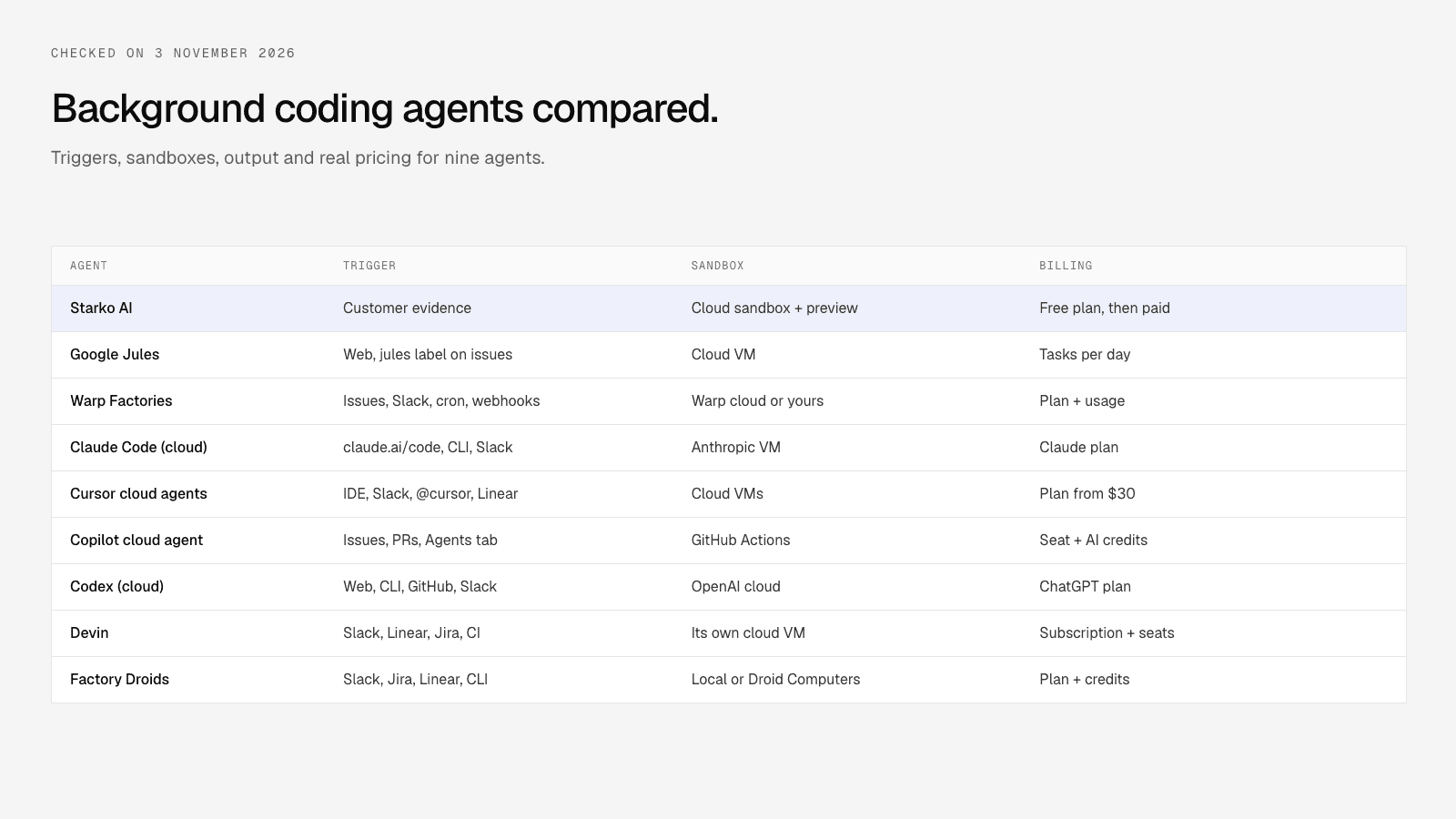
The reference table: nine background coding agents, checked on November 3, 2026
Every row below was checked against the vendor's own product page, docs or pricing page on November 3, 2026. Prices are list prices per month in US dollars unless noted. Plans change often, so follow the pricing link before you buy.
Two patterns stand out. First, almost every agent now runs in an isolated cloud VM and returns a pull request, so those columns no longer separate anyone. Second, the input and output columns still do: where the task came from, and how much of what comes back you can check without redoing the work.
A note on what's missing. Factory's homepage talks about reviewing pull requests but not opening them; its Linear docs are where the pull request behavior is written down, and they say "instructed to," which we've kept. Jules' paid tiers are bundled into Google AI subscriptions, and we couldn't confirm the Ultra price on a Google page, so we left prices out of that row.
What does the 2026 data say about agents in real repositories?
Agent-written pull requests are no longer an experiment. In its Octoverse 2026 report, published October 28, 2026, GitHub found that more than 40% of pull requests on GitHub in September 2026 started with an agent's first draft, up from 17% in March. GitHub calls that figure a floor, because it only counts agents it can detect ().
Those pull requests also land. By September, 90% of agent-started pull requests merged within two weeks, against about 86% for pull requests without detected agent involvement, according to the same report. In February the agent figure had been 83%.
Developers say the same thing in surveys. The Stack Overflow 2026 Developer Survey found coding assistants and agents are the most common use of AI at work, at 66% of respondents. It also found 48% trust AI output when they can easily validate it (). Keep that second number in mind for the next section.
Now the uncomfortable part. Faros AI's 2025 telemetry from more than 10,000 developers on 1,255 teams found that teams with high AI adoption merged 98% more pull requests, but pull request review time rose 91% and average pull request size grew 154% (). Faros sells engineering analytics, so treat this as vendor research. The direction matches what most teams report anyway.
And writing code was never most of the job. Atlassian's State of DevEx 2025 survey of 3,500 developers and managers found developers spend 16% of their time coding, and half lose 10 or more hours a week to organizational inefficiency ().
Review is the bottleneck now, not typing
Put those numbers together and the conclusion is blunt. Code got cheap. Two things did not: deciding what's worth building, and checking that what came back is right.
Most comparisons rank background coding agents by benchmark scores and price per task. We think that's measuring the wrong end. If an agent writes a correct fix in eight minutes and your reviewer needs forty to trust it, the agent saved you nothing. If the task it was given was the wrong task, it saved you less than nothing.
So the two questions we'd ask of any agent are upstream and downstream of the code. Upstream: how good is the task it starts from? A one-line Slack message ("export is broken on Safari") forces the agent to guess at reproduction steps, browser version and expected behavior. A task that arrives with the customer's own words, a session recording and the console error doesn't.
Downstream: what does it hand the reviewer? The Stack Overflow finding fits here. People trust AI output when it's easy to validate, and a pull request is only easy to validate when it shows its work.
How do you judge what an agent hands the reviewer?
Open the last five pull requests an agent made in your trial and check each one against this list. It takes ten minutes and tells you more than any benchmark.
- A reproduction. Did the agent show the bug happening before it changed code? "Could not reproduce" is an acceptable answer. Silence is not.
- Real test results. Did tests run in the sandbox, with the actual command and exit code, or does the description just claim they pass?
- Visual proof. For anything a user sees, a screenshot or short video of the fixed state. Cursor and Warp both attach these; it should be table stakes.
- The reason the work exists. A link to the issue, conversation or report that triggered it, so the reviewer can check the fix against the original problem rather than against the agent's summary of it.
- Scope and risk. What the change deliberately does not touch, and which areas it might affect.
- Size. Faros' 154% growth in pull request size is the thing to watch. Small, single-purpose pull requests get reviewed; big ones get rubber-stamped or ignored.
If an agent scores well here, its price per task barely matters. If it scores badly, a cheap agent becomes an expensive one the moment a reviewer has to rebuild its reasoning from scratch.
Where does Starko AI fit, and where does it not?
Starko AI is the coding agent inside , and its row in the table differs mainly at the two ends we just argued about. The work usually starts from customer evidence: Starko reads support conversations, session replays around errors and rage clicks, and JavaScript errors on your pages, then groups them into a recommendation. Nothing is built until someone accepts it. You can also start a run by mentioning @starko on any ticket or clicking "Fix with Starko AI", and each project sets whether complete bug reports may start on their own, capped by a monthly budget of automated runs.
Each run gets a fresh with your repository, Docker Compose services and a Chromium browser, and you can open a live preview of the app while the agent works. The agent tries to reproduce the problem first. The draft pull request it opens has fixed sections for problem, reproduction, fix, verification, risk and out of scope. A separate reviewer agent and your CI read it before a person does, and after the agent finishes, Starko re-runs your test commands and records the real exit codes, marked "Verified by STARKO", rather than trusting the agent's own account of what it ran.
Merging stays with you. You merge from the ticket, or turn on automatic merging for reviewed, green and conflict-free pull requests during setup, with branch protection still applying. Closed and reverted pull requests are tracked as outcomes, so the dashboard's merge rate and cost per merged pull request stay honest.
Where it doesn't fit: Starko AI is built to fix what customers run into. It isn't a general agent for a large refactor, a new service from a blank repo, or a migration across ten repositories. For that work, Codex, Claude Code, Devin, Cursor or Factory are better picks, and the table above should help you choose between them. Starko's MCP server can sit next to them inside Claude, Cursor and VS Code, but it doesn't run those agents for you. If you want the longer argument for starting from customer evidence, it's in .
How to pilot a background coding agent in one week
You don't need a quarter-long evaluation. Five working days and one real backlog will tell you whether an agent earns a place on your team.
- Monday: pick 10 real tasks. Take them from your actual backlog, not toy examples. Mix three tiny bugs, four medium bugs and three small features. Write down how long each would take a person.
- Monday afternoon: set up the environment properly. Give the agent a working test command and a way to start the app. Most bad first impressions come from a sandbox that can't run anything.
- Tuesday and Wednesday: delegate everything, the way your team actually would. If tickets usually start as one line in Slack, give the agent one line in Slack. You're testing your inputs as much as the agent.
- Thursday: review with a stopwatch. For every pull request, time how long a reviewer needs to reach a confident yes or no, and score it against the checklist above.
- Friday: count three numbers. Merge rate, median review time and total cost divided by merged pull requests. That last figure is the only price comparison that means anything.
Run the same ten tasks through two agents if you can. The gap in review time is usually bigger than the gap in cost.
Frequently Asked Questions
What is a background coding agent?
A background coding agent is an AI agent that takes a coding task, works on it in its own cloud machine without a person watching, and returns a branch or pull request for review. Unlike an IDE assistant, it runs while you do other work and can handle several tasks in parallel.
Are background coding agents the same as cloud coding agents or async coding agents?
Mostly, yes. Vendors use all three names for agents that work remotely and asynchronously. Cursor, for example, now calls what it used to name background agents "cloud agents". The useful distinction is between agents that work beside you in an editor and agents you hand work to and check later.
How much do background coding agents cost in 2026?
Entry plans with cloud agents run from $10 a month (GitHub Copilot Pro) to $30 (Cursor Premium), with heavier tiers at $100 to $200 and team plans priced per seat. Most also meter usage through credits or allowances. Total cost divided by merged pull requests is the fairest way to compare them.
Which background coding agent is best?
It depends on where your work starts. Teams living in GitHub issues will find Copilot's cloud agent the shortest path. Teams that delegate from Slack, Linear or Jira should look at Devin, Cursor, Factory or Warp Factories. For customer-reported bugs, an agent that starts from the customer evidence saves the most review time.
Can a background coding agent merge code on its own?
Most can be configured to, but the default everywhere in this comparison is a pull request that a person merges. Branch protection still applies. Keep human merge on until your review data shows a class of change that is consistently safe to automate.
Do background coding agents replace code review?
No. They move work into review. GitHub's Octoverse 2026 shows agent-started pull requests now merge at a high rate, and Faros AI measured a 91% rise in review time on high-adoption teams. Review gets more important, which is why the evidence an agent attaches matters so much.
Where to go from here
If your backlog is mostly things customers ran into, it's worth seeing what an agent does when the task starts from their evidence instead of a one-line ticket. .
Related: ·